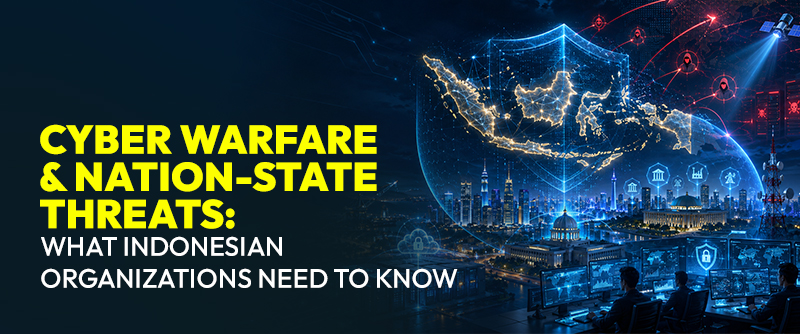
Nation-state activity in cyberspace has moved from academic concern to an operational reality for organisations across Southeast Asia. Indonesian entities now face targeted, sophisticated campaigns that seek strategic advantage, access to intellectual property, and disruption of critical services. One phrase that captures this environment is nation state cyber threats in Indonesia, which combines geopolitics with persistent technical intrusions. For boards, CISOs, and risk teams, the imperative is clear: treat state-level intrusions as a different class of adversary that plans for long dwell times, custom tooling, and careful operational security. This post explains who these actors are, why Indonesian organisations are attractive targets, and what practical, proportionate defenses and governance steps will materially reduce risk.
Cyber warfare refers to politically motivated, state-directed operations intended to gather intelligence, degrade infrastructure, or influence decision-making through digital means. Unlike generic cybercrime, nation-state operations often combine espionage, sabotage, and information operations, run with strategic objectives rather than immediate financial gain.
Adversaries can include foreign intelligence services and state-sponsored advanced persistent threat groups. These actors frequently reuse sophisticated tooling, compromise supply chains, or exploit zero-day vulnerabilities. Recent global reporting shows an uptick in state-nexus espionage activity that affects government and industry across the region.
Indonesia’s rapid digitisation and its central role in regional trade make it an attractive environment for strategic cyber operations. The country’s mix of large financial institutions, government services, energy infrastructure, and a growing digital economy provides high-value targets. In mid-2024, a major ransomware attack against the national data centre disrupted immigration services and affected more than 230 agencies, underscoring operational exposure and governance gaps. That incident highlighted common weaknesses: optional backup policies, inconsistent patching, and decentralised procurement decisions.
Recent threat reports and vendor analyses show persistent targeting of diplomatic, energy, and financial sectors in Indonesia by actors conducting long-term reconnaissance before exploiting supply chains or trusted third parties. Public sector digital services, health records, and critical infrastructure are notable prize targets because disruption generates political leverage. The National Cyber and Crypto Agency, known as BSSN, has documented rising attack volumes and is actively pushing national coordination, but implementation across many agencies remains uneven. This combination of valuable targets, mixed maturity, and regional geopolitics explains why nation state cyber threats in Indonesia are a present-day operational reality.
The presence of nation-state activity changes both the technical and governance posture required of organisations. Operationally, organisations should assume that targeted adversaries will try to gain persistent access and to blend into normal operations. Consequences range from intellectual property loss and financial fraud to prolonged outages that erode public trust and regulatory standing.
From a compliance perspective, heightened scrutiny from regulators and auditors is likely after major incidents. Organisations must be able to prove governance, incident readiness, and supply-chain oversight. Insider risk also becomes more significant because state-level actors often seek human vectors or coercion to gain privileged access. External third parties and managed service providers represent additional attack surfaces that can be turned into staging points.
The business case for proactive defenses is straightforward: the incremental cost of stronger fundamentals, including segmented networks, hardened authentication, logging, and rapid detection, typically undercuts the potentially catastrophic operational and reputational costs of a successful targeted intrusion. Framing investment as risk reduction against high-impact scenarios makes it easier to secure board-level buy-in.
Below are practical, evidence-led measures that materially reduce the likelihood and impact of state-level intrusions.
Build an internal capability or engage trusted providers to ingest threat intelligence relevant to the region and your sector. Map intelligence to use cases: detection rules, IOC ingestion, and executive briefings. Operationalise a 24/7 monitoring and escalation model that includes endpoint telemetry, network flows, and cloud logs. Use threat intelligence to prioritize patches and hardening activities.
Move away from implicit trust models. Implement least privilege identity controls, multi-factor authentication across admin and privileged accounts, micro-segmentation for critical assets, and strong encryption for data at rest and in motion. Architect environments so compromise of one element does not grant free rein across systems.
Create and regularly exercise a scalable incident response plan that includes legal counsel, communications, forensic capacity, and escalation to national CERT or BSSN when appropriate. Tabletop exercises should simulate prolonged intrusions and supply-chain scenarios, not just commodity ransomware.
Treat vendors and managed providers as crown jewels from a security perspective. Enforce contractual security requirements, require evidence of testing and audits, and verify software provenance. Maintain an inventory of critical third parties and plan compensating controls for higher-risk suppliers. Lessons from global supply-chain compromises demonstrate the speed at which trusted software or services can become vectors.
Share actionable indicators and anonymised incident data with BSSN and sectoral ISACs. Public-private collaboration compresses detection timelines and helps align protective measures across an ecosystem that adversaries target collectively. Participation in Indonesian cyber intelligence exchanges and information sharing improves national situational awareness.
Technical controls matter, but human factors drive many compromises. Invest in targeted training for admins and executives, robust access reviews, and a security-aware procurement process. Encourage reporting of anomalies and make security part of performance metrics for teams that manage critical systems.
Implementing these measures in layers reduces both the chance of successful intrusion and the damage if an adversary gains entry. Prioritise actions based on threat intelligence and business impact to deliver measurable improvement within realistic budgets.
IndoSec provides a focused forum where Indonesian CISOs, government cyber leaders, vendors, and policy experts converge to translate strategic threat intelligence into operational practices. The summit’s agenda emphasizes cross-sector case studies, regional threat briefings, and practical sessions that address the governance gaps exposed by recent incidents. Attendees gain exposure to global tech vendors and can assess capabilities in areas such as incident response, secure architecture, and supply-chain assurance. For organisations seeking to align internal programs with national strategies and to build trusted partnerships across public and private sectors, IndoSec and related cyber defense expo sessions offer concentrated, actionable value. As one of the leading cybersecurity industry events, IndoSec brings the industry’s best experts, strategies, insights and solutions under one roof.