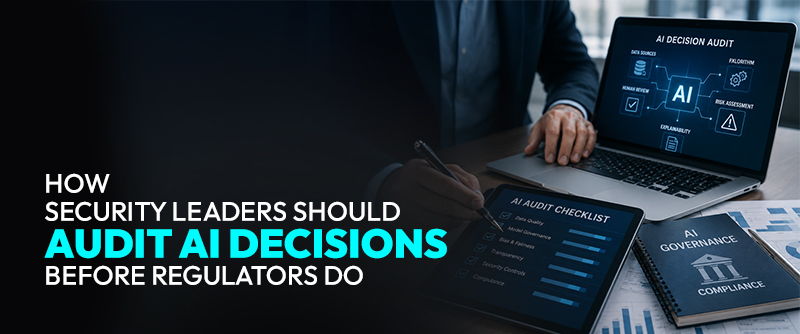
Auditing AI decisions before regulators requires keeping a documented record of what data a system uses, who holds the authority to override its output, and why it reached a particular decision. In Indonesia, government agencies already use AI for citizen chatbots, document verification, and welfare fraud detection – often without that kind of record-keeping in place.
With regulators moving faster than many organizations anticipated, cyber risk management in Indonesia is becoming a strategic priority instead of merely a compliance exercise. Organizations that delay implementation often identify gaps only after an automated decision is challenged, forcing reviews to take place under scrutiny instead of through planned governance processes.
Regulators scrutinize AI decisions because unexplained automated outcomes create legal and reputational exposure the moment a citizen disputes one.
Public sector AI adoption has historically prioritized deployment speed over governance. South Korea’s Basic AI Act, which takes effect on January 22, 2026 – ahead of the European Union’s AI Act – requires generative AI systems used in public services to implement documented safeguards rather than relying on simple disclaimers. This shift is already influencing public procurement, with vendor contracts increasingly including audit-access clauses.
Auditors typically examine three key areas: the data an AI system uses, whether humans can override its decisions, and whether its outputs can be meaningfully explained. Effective generative AI governance requires documenting these elements before an official review. By maintaining clear audit records in advance, agencies are better positioned to demonstrate compliance and respond confidently during regulatory investigations.
While compliance timelines are being extended in some areas and remain unchanged in others, both developments require equal attention.
The EU AI Act has extended compliance deadlines for high-risk AI systems: obligations for standalone systems under Annex III now apply from December 2, 2027, while product-embedded systems covered by Annex I are deferred until August 2, 2028. However, the transparency obligations under Article 50 still take effect on August 2, 2026, with the transitional deadline for certain AI-generated content marking requirements following on December 2, 2026.
Indonesia’s Ministry of Communication and Digital issued Circular Letter No. 9 of 2023 on AI ethics, while a draft Presidential Regulation on AI ethics and safety is expected to move the country towards a binding, risk-based regulatory framework.
Many agencies lack the documentation needed to demonstrate effective cyber risk management because their systems were never designed to produce a reliable audit trail. Retrofitting records in response to an audit or regulatory request is significantly more time-consuming than generating them as part of normal operations.
Moreover, documentation gaps identified under regulatory scrutiny are far more difficult to justify than those discovered and addressed through routine internal reviews.
An internal audit framework starts by identifying which AI systems exist before deciding how to govern them.
List every model, script, or vendor tool influencing a citizen or budget decision, including tools bundled inside larger software that procurement teams may not have flagged as AI at the time of purchase.
Group systems according to the potential consequences of incorrect or harmful outputs rather than how frequently they are used. This approach aligns with leading cybersecurity and AI governance frameworks, including ISO/IEC 42001 and the NIST AI Risk Management Framework, which classify risk based on the severity of potential impacts rather than the frequency of system use.
Every system needs one named, accountable owner, not a rotating committee. Regulators request a name, not a department, and an unclear ownership chain is often the first finding in any formal review.
The examination should follow the same consequence-based logic used across top cybersecurity governance models already applied in regulated industries.
Common oversight gaps include assuming that a vendor’s compliance certification automatically extends to an agency’s specific use case, failing to review contractual obligations when AI capabilities are introduced, and deleting decision logs before retention requirements have been met.
In addition, informal exception tracking often lacks clear links to the original system decisions, reducing traceability and accountability. Addressing these documentation gaps does not necessarily require new technology; instead, it requires regular internal reviews to ensure that existing governance processes are consistently applied and documentation remains complete and auditable.
IndoSec brings security, risk, and compliance leaders together specifically to close the documentation gaps described above. The upcoming edition, scheduled for 15–16 September 2026 at The Ritz-Carlton Jakarta, Pacific Place, will offer expert-led sessions on Zero Trust adoption, PDP Law enforcement, and AI-driven defence, drawing more than 2,000 attendees from government and industry.
For teams building an internal audit process, a conference at this scale offers direct access to peers who have already mapped their AI inventory and assigned ownership, shortening the path from policy draft to working audit trail – giving security leaders a realistic sense of where their own agency stands by comparison.
Don’t miss out. Register for IndoSec 2026 today!
What is the first step in auditing government AI systems?
Security teams should first build a complete inventory of every AI tool influencing citizen-facing decisions before assigning risk levels.
Does Indonesia already regulate AI decisions used in government services?
Current rules rely on the Personal Data Protection Law and a 2023 ethics circular, with a binding regulation in draft.
How often should AI audit frameworks be reviewed?
Review the framework quarterly and immediately after any vendor update that changes how a system reaches its decisions.
What role does AI play in a cybersecurity conference?
Conferences like IndoSec let security leaders compare oversight practices and regulatory timelines before formal audit requirements take full effect nationally.
Who should own AI decision audits inside a government agency?
An accountable individual should own each system so regulators always have a clear point of contact.